
A 4 channel wireless microphone system is the smallest configuration that still covers a real performance: three vocals plus a guitar, four people on a panel, or a worship team with one spare transmitter for the talkback. It is also the point where wireless stops being plug-and-play. Four transmitters sharing one rack compete for the same spectrum, and the fourth channel is usually the one that exposes a frequency plan that was never a plan at all. Every figure below comes from published product data, not a demo room.

What the fourth channel actually changes
With one channel you scan for a quiet frequency and you are finished. With four, the receivers stop listening only to the transmitters. Every pair of transmitters can generate intermodulation products, and the number of those products grows much faster than the channel count does. Two transmitters create a handful; four create a dense grid, and some of it lands close to the frequencies you just chose.
That is why a four-channel system behaves differently from four single-channel systems even when the receivers are identical. The failure mode is not "channel four is broken". It is that channel four sounds perfect at line check, then develops hiss or a dropout the moment the vocalist on channel two starts moving — because the interference is a product of both signals, not a property of either channel.
Two design choices answer this, and both are visible on the hardware rather than in the marketing copy:
- Groups that are calculated together, not scanned independently. A group is a set of frequencies already checked against each other for intermodulation. Four channels from one group will coexist; four picked one at a time may not.
- Enough tuning range to move. If the local television allocation eats the middle of your band, you need somewhere to go. The X4 receiver offers 64 pre-set groups and 1200 frequencies, which is what makes a re-plan possible at 6pm on a show day.
The specifications that decide whether four channels stay clean
Receiver front end: true diversity and honest sensitivity
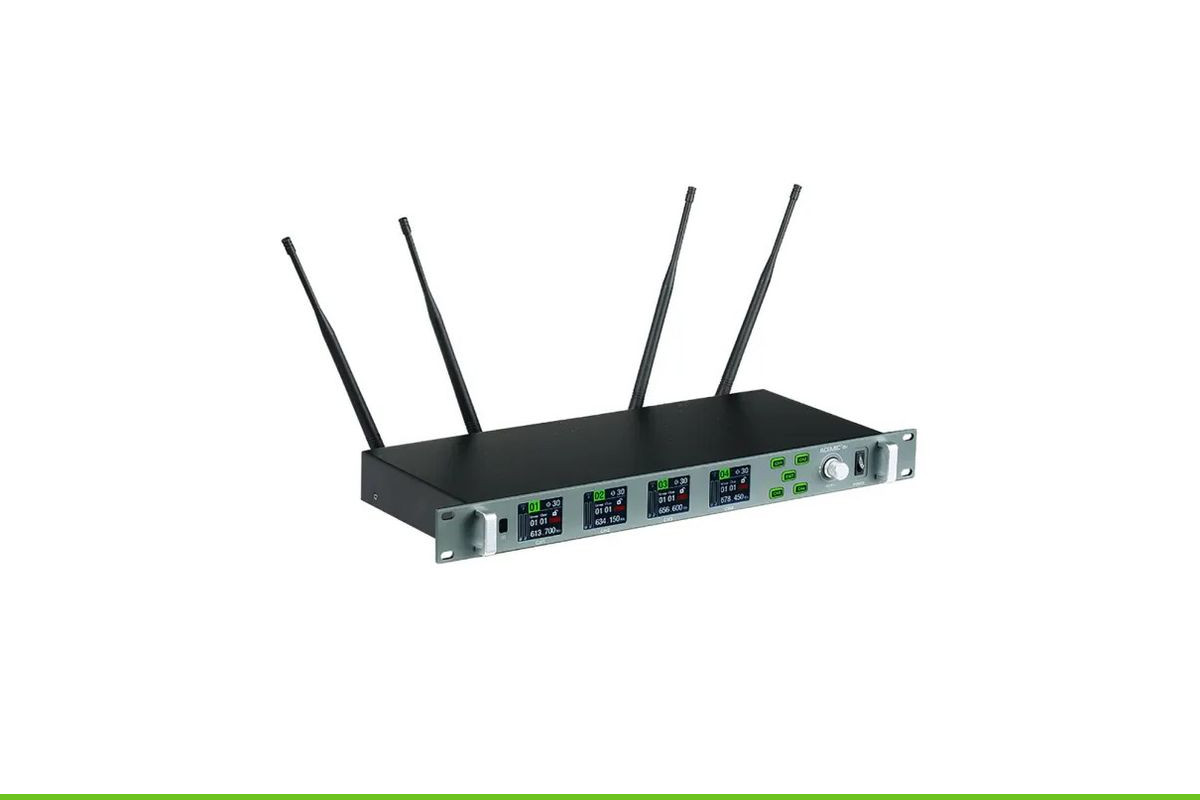
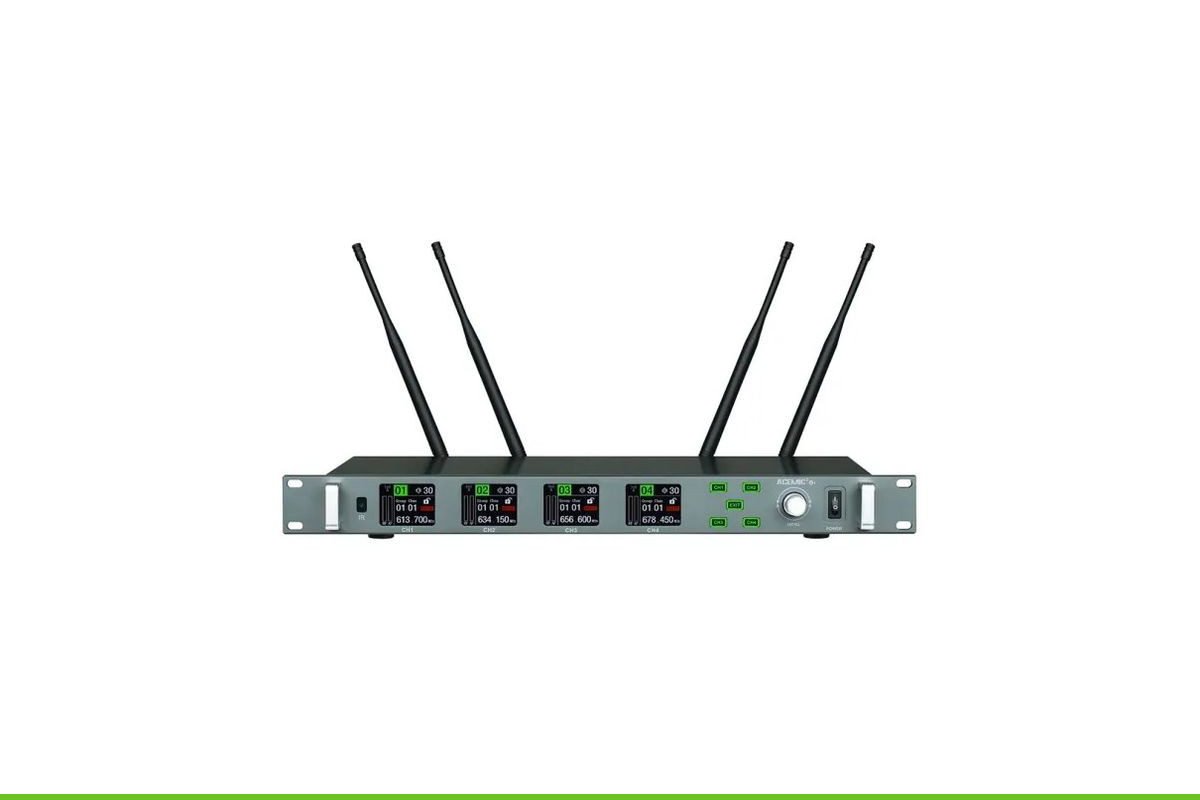
True diversity means two complete front-ends per channel and an audio path that switches to whichever antenna currently has the cleaner signal. It matters more at four channels than at one, because the chance of at least one transmitter sitting in a reflection null rises with every channel you add. On the X4/MicB four channel stage system, each channel carries its own pair of antennas — the front panel shows four pairs, not one shared pair feeding a splitter.
Numbers behind that receiver: sensitivity of -105 dBm at 12 dB SINAD, image rejection above 100 dB, signal-to-noise of at least 110 dB, dynamic range of 118 dB, and distortion under 0.5% at 1 kHz across 35 Hz to 20 kHz. Sensitivity is the figure to read carefully on any data sheet. A receiver that only reaches usable audio at -95 dBm works at short range and then falls apart exactly when the performer walks to the back of the room.
Transmitters: RF power, deviation and real battery life
Four transmitters mean four batteries that all have to survive the same two-hour set. The X4 handheld and bodypack transmitters run on a 14500 lithium cell or a single 1.5 V AA, with a published continuous use figure of 10 hours — roughly five shows of headroom on one charge. RF output switches between 15 mW and 30 mW, with maximum deviation of 65 kHz.
Higher power buys range and costs battery life and spectrum friendliness. In a 200-capacity room, the lower setting is usually the better engineering choice rather than the compromise.
Frequency plan: bands, groups and regional variants
The X4 receiver tunes UHF 610-698 MHz in its standard configuration, with regional variants at 902-928 MHz for the USA, 823-832 and 863-865 MHz for the UK, and 925-937 MHz for South Korea. Bandwidth is 42 or 60 MHz depending on variant, with 6000 maximum tunable channels, frequency stability of ±10 PPM, and a spectrum scan that reads the RF environment before you commit.
Confirm the variant before ordering, not after. A receiver covering the wrong band is not something a menu setting fixes, and importing the wrong variant is the most expensive common mistake in four-channel installs.

Four-channel configurations compared
ACEMIC builds the same four-channel receiver platform in several transmitter configurations, plus a lower-cost alternative for fixed installs. The differences that matter are transmitter type, tuning range and sync method.
| Model | Transmitters | Range (line of sight) | Tuning | Best for |
|---|---|---|---|---|
| X4/MicB | 4 × handheld, cardioid dynamic | 150 m / 492 ft | 64 groups, 1200 frequencies, spectrum scan | Four vocalists, club and rock stages |
| X4/BP-BH | 4 × bodypack with headset | 150 m / 492 ft | 64 groups, 1200 frequencies, spectrum scan | Theatre, dance, presenters who need their hands |
| EU-864 | 4 × handheld, or handheld plus bodypack | 100 m / 328 ft | 800 frequencies (200 × 4), IR sync | Fixed installs, schools, value-driven projects |
Both X4 variants share one receiver specification: 118 dB dynamic range, 110 dB signal-to-noise, image rejection above 100 dB, and a chassis that mounts on standard rack ears. Choose the X4/BP-BH headset configuration when the four channels have to disappear onto four performers rather than sit on four mic stands.
The EU-864 is the pragmatic fixed-install choice: 600-937 MHz tuning, 800 selectable frequencies, digital pilot tone for interference rejection, IR sync that copies frequency from receiver to transmitter, an LCD showing frequency plus AF and RF level, and an EIA-standard 1U metal chassis. It gives up range against the X4 and gains a simpler setup routine.
Setting up four channels without dropouts
The order of operations matters more than any single setting. Do these five steps in sequence and most four-channel problems never appear.
- Rack the receiver with the antennas in front. Antennas at the back of a metal rack, among power amps and LED drivers, is the most common cause of dropouts. Keep line of sight to the stage.
- Turn every transmitter off, then scan. A scan performed with transmitters running measures your own signals and tells you nothing about the room.
- Assign all four channels from one group. Use the pre-set groups rather than four independent manual picks. Groups are calculated as a set; manual picks are not.
- Keep guard spacing between carriers. If you must leave the groups, keep at least one channel-width between any two carriers and re-check for interference afterwards.
- Walk test, then lock. Walk the performance area with all four live, watch the RF metering per channel, then engage the receiver's lock function so nobody changes a setting mid-show.
What to check before you commit
- Band variant for your country. Confirm the tuning range in writing on the order. The correct answer for the USA is not the correct answer for the UK.
- Transmitter mix. Four handhelds, four bodypacks, or a split — the configuration is built at the factory, so decide before ordering.
- Sync method. IR sync copies frequency in seconds. Manual entry works, but it is where setup errors happen under time pressure.
- Documentation and support. A four-channel rack is infrastructure. The manual and a reachable manufacturer matter more than a badge on the panel.
Frequently asked questions
Is a 4 channel wireless microphone system enough for a live band?
For most working bands, yes. Three vocal microphones plus one instrument channel covers the typical four-piece, and the fourth channel can be reassigned to a second guitar or a talkback mic. If you run five or six open microphones, buy eight channels in one coordinated group rather than adding a second four-channel rack in another band.
How many of these systems can run in the same venue?
The X4 platform is specified for up to ten sets operating simultaneously, 40 channels in total. That is achievable in a large venue with coordination, but it depends on local spectrum, band variants and antenna placement. Treat it as a planning ceiling, not a default.
What is the real difference between four channels in one rack and four separate systems?
One chassis, one power supply, one scan routine and one coordinated frequency group. The important one is the last: frequencies inside a group are checked against each other, while separately bought systems are tuned one at a time and often conflict on show day.
Do I need a licence to operate a UHF wireless microphone system?
It varies by country and band. Some ranges are licence-exempt in specific territories while others require a licence or are reserved for other services. Check your national telecom regulator for the exact band you are importing, and ask us for the variant your market needs before ordering.
Can I mix handheld and bodypack transmitters on the same receiver?
The X4 receiver platform is offered with handheld, headset and lavalier transmitters, and mixed configurations are built at the factory. Tell us the mix you need — three handhelds plus one headset, for example — and it ships configured that way rather than being adapted afterwards.
Pick by the job, not by the data sheet: a club stage with four vocalists wants the handheld version and its 150 m working range, a theatre wants the bodypack version, and a school with a controlled layout gets what it needs from the EU-864 at 100 m. Browse the full wireless stage microphones collection, compare against the larger wireless microphone systems range, or apply as a dealer and write to ak@acemic.store with the configuration and quantity you need. We build in Enping, Guangdong and ship factory direct, with OEM and private label programmes on qualified volume orders.