
A pro stage wireless microphone system is not defined by its channel count or by how many digits sit after the decimal point in the spec sheet. It is defined by what happens at minute 97 of a two-hour set, when the room is full, the guitarist has walked in front of the rack, and the vocalist is 40 metres from the receiver. If the RF link holds, the system is professional. If it does not, nothing else on the data sheet matters.

This guide covers how stage systems fail, which specifications map to reliability, and how to match a system to the job — from a three-piece club act to an eight-channel church install. Every model referenced is a current ACEMIC production unit.
What "stage-grade" really means in a wireless microphone system
Studio wireless and stage wireless are different engineering problems. In a studio you control the RF environment, the distance and the channel count. On a stage you control almost nothing: the venue adds new reflections every night, the audience absorbs and scatters UHF energy, and lighting rigs, LED walls and in-ear feeds all add noise to the spectrum.
Stage systems defend against that with a few specific choices:
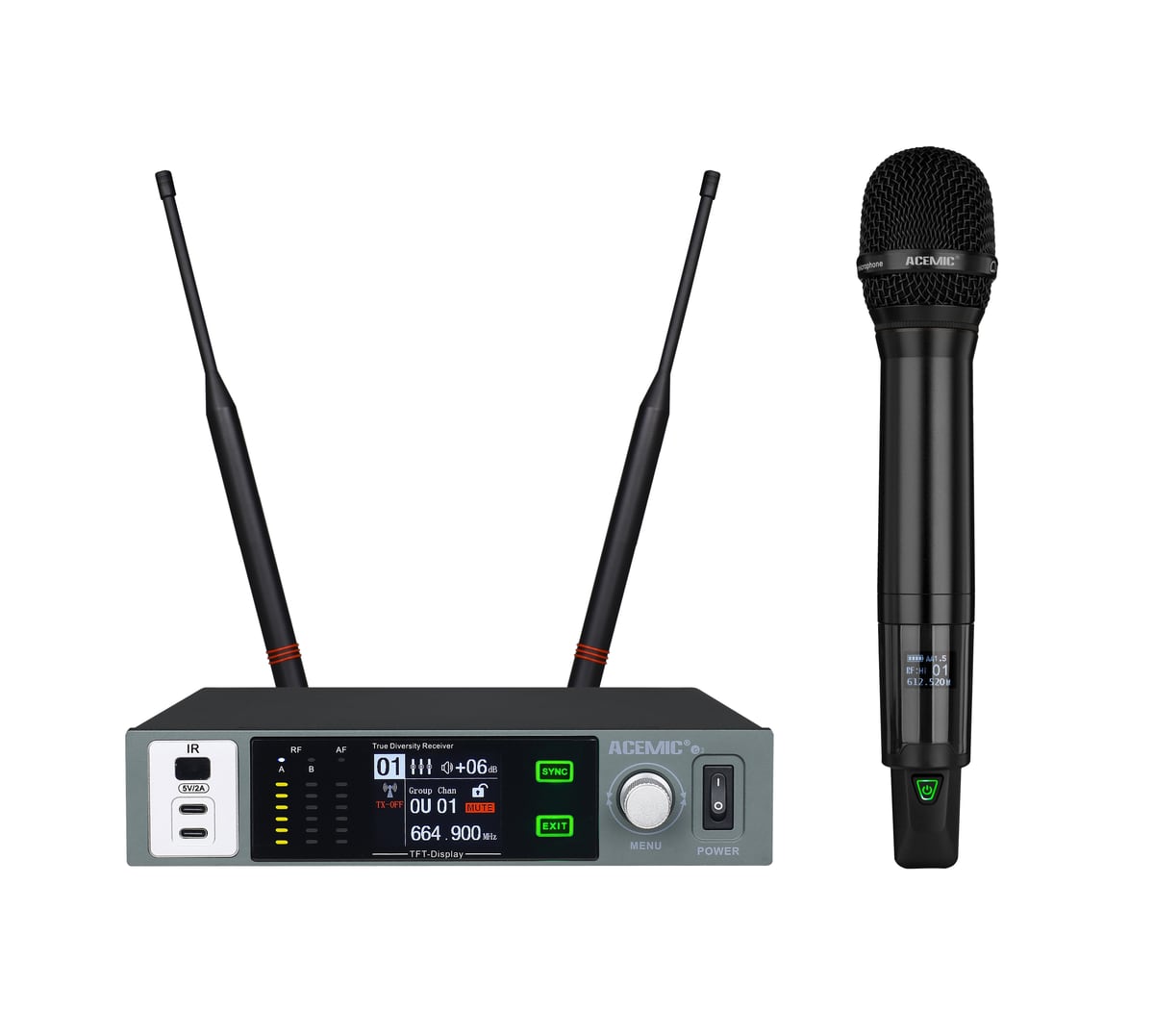
- True diversity reception. Two independent antenna front-ends and two receiver chains, with audio taken from whichever antenna currently has the cleaner signal. Look at the front panel of the G4B/Beta87A receiver — the "true diversity receiver" marking is not decoration. A single-antenna receiver with a splitter is not diversity.
- Metal-bodied transmitters. Plastic bodies flex, and flexing bodies crack solder joints and shift antenna grounds. Metal also shields the transmitter from the hand capacitance that detunes an antenna when a performer grips a mic tightly.
- Honest front-panel metering. A receiver showing full RF bars right up to the moment of dropout is worse than useless, because it removes your ability to plan. You want to watch the signal degrade gradually as the performer walks the room.
- Audio headroom. Stage SPL is unpredictable. A system that clips on a loud chorus and one that survives it can carry identical nominal specifications.
Judge a stage system by stability margin, not peak performance. Peak performance is what a quiet demo room shows you; stability margin is what keeps the show running.
The four failure points that end a show early
1. RF dropout from a coverage hole, not a weak system
Most "the mic cut out" reports are coverage problems: a receiver inside a metal rack, antennas at the back of the rack, or a performer walking behind a stage column. Fix antenna position, rack placement and line of sight before blaming the hardware. Systems with true diversity and front-mounted antennas, such as the G4/MicF, tolerate compromised placement far better than single-antenna designs, because they can switch away from the antenna that is being blocked.
2. Spectrum congestion from too many channels in one band
Every open channel needs guard spacing. Six handhelds crammed into a narrow slice of UHF will intermodulate, and the resulting interference appears as random noise bursts — usually blamed on the transmitters. If a production needs eight vocal channels, plan the frequency scheme as a system, not as eight independent purchases. The G4B 8-channel combo pack exists because coordinated multi-channel operation is an engineering problem, not a shopping problem.
3. Battery behaviour under load
Alkaline cells sag under continuous transmit current and discharge non-linearly. A transmitter reading "full" at soundcheck can hit the low-battery warning forty minutes into the set. The professional habit is not a better battery — it is a fixed replacement schedule tied to show length, plus a battery indicator a stage manager can read from a metre away.
4. Handling noise and capsule choice
A stage handheld is a mechanical device attached to a moving human. Handling noise, cable rustle on bodypacks and capsule voicing all sit in the audio path before the wireless link does anything. Capsule selection matters as much as the RF section: the G4/MicB and the G4B/Beta87A share an RF platform family but prioritise different voicings — one for singers who work close and want presence, the other for large stages where a brighter capsule must cut through a loud band.
Pick by transmitter type, then by channel count
The fastest way to narrow a stage wireless purchase is to start from what each performer actually holds, then decide how many channels you need.
Handheld systems cover vocals, MC work and any position where the performer moves with a mic in hand. A dual handheld system with a rack-mount receiver is the standard building block of a small stage rig.
Bodypack systems cover headset, lavalier and instrument applications — theatre, presenters, preachers, guitar and bass. The trade-off is cabling: a bodypack is only as reliable as its connector and belt clip.
Plug-on transmitters are the most under-used tool on a stage. A plug-on XLR transmitter turns any existing wired dynamic microphone into a wireless channel without buying a new capsule. If you already own good wired mics, the G4/TR-1 XLR wireless transmitter and receiver converts them instead of replacing them — often the cheapest real upgrade available to a small venue.

ACEMIC stage systems compared
The table maps current ACEMIC stage models to the job each one is listed for. Channel counts and working-range figures are quoted as published on each product page; nothing here is extrapolated.
| Model | Transmitter options | Listed use case | Best fit |
|---|---|---|---|
| G4/MicB | Handheld | Singers, close-mic vocal work | Club and small-stage vocals |
| G4/MicF | Handheld | Large stage, 300 m listed working range | Long-throw rooms, outdoor stages |
| G4B/Beta87A | Handheld, Beta87A-type capsule | Large stage performance | Lead vocal in a loud band |
| G4A/Beta87A | Handheld, Beta87A-type capsule | Stage performance | Second vocal channel, matched voicing |
| G4/TR-1 | Plug-on XLR | Wireless conversion of wired mics | Venues upgrading existing capsules |
| X4/MicB | Handheld, 4 channel | Multi-performer stage | Four vocal positions on one rack |
| G4B combo pack | Mixed, 8 channel | Full band or fixed install | Houses of worship, small theatres |
Two notes. A higher channel count is not a quality upgrade — it is a coordination burden; eight channels need a frequency plan, four usually do not. And capsule families matter when models are mixed on one stage: a bright and a neutral capsule on two vocalists who trade lines forces EQ workarounds all night. Keeping matched capsule families, as across the wireless stage microphones range, removes that problem.

Specifications that matter, and the ones that are decoration
Spec sheets are written to be compared, not understood. Here is how to separate the two categories.
Matters: receiver architecture. True diversity with two real RF front-ends. If the sheet lists one antenna input, the product cannot be true diversity. Matters: frequency agility and coordination. The ability to move a channel when the venue's spectrum is dirty, and to plan multiple channels without intermodulation — on a stage, agility is a recovery mechanism that lets you fix a problem in ninety seconds instead of cancelling a set. Matters: front-panel information density. Group, channel, frequency, RF level, AF level and battery, all readable at once, in a dark room, from a metre away. Matters: build and connectors. Metal chassis, well-retained connectors, and antennas that mount at the front of a rack rather than the rear.
Mostly decoration: THD figures below the audible threshold, signal-to-noise ratios beyond about 100 dB, and channel counts in the thousands that describe synthesizer capability rather than usable simultaneous channels. None of these will rescue you from a coverage hole.
Building a rig that scales
Most buyers start with one dual handheld system and add later. Two choices keep that path open. Buy a rack-mountable receiver with front antennas from day one — retrofitting antennas costs more than buying them. And standardise on one transmitter family so batteries, capsules and spares stay interchangeable; a mixed inventory of four brands means four battery types and no way to swap a failed transmitter mid-show. Plan monitoring at the same time: in-ear and microphone systems both consume spectrum and should be frequency-planned together, not one after the other.

Frequently asked questions
What is the difference between true diversity and antenna diversity?
True diversity uses two complete receiver front-ends and switches the audio path between them. Systems marketed as "antenna diversity" often switch only the antenna input into a single receiver chain, which does not provide the same protection against multipath dropouts. Ask for the block diagram, not the badge.
How many wireless channels can I run at once on a stage?
It depends on the band, spacing plan and local spectrum, not the receiver's channel count. Eight coordinated channels is realistic for a well-planned install; beyond that you need coordination tools and usually more than one band.
Can a plug-on transmitter really replace a wired microphone?
Yes, for dynamic handheld and instrument mics with an XLR output. It adds the wireless link while keeping the capsule you already trust, so the audio signature stays unchanged.
What should I check first when a channel drops out?
Antenna position and line of sight, then the frequency plan, then battery under load. Only after those three should you suspect the hardware — usually it is reporting a problem created elsewhere.
Are these systems available for OEM and private label programmes?
Yes. ACEMIC manufactures in our own facility in Enping, Guangdong, and supplies stage wireless systems for OEM, ODM, wholesale and private label programmes, with CE, FCC and RoHS documentation available on request.
Next step: browse the full wireless microphone systems collection to compare current configurations, or contact our team for dealer pricing and OEM enquiries.