

A museum tour is an audio problem before it is a radio problem. A guide speaks at a comfortable volume and thirty visitors stand in a hall with stone floors and six-metre ceilings. A wireless tour guide system puts that voice into each visitor's ear at conversational level, up to 150 m / 492 ft away. Every kit in the ACEMIC TG range shares one 2.4 GHz GFSK link, 9,999 ID codes, a 1,300 mAh transmitter rated 25 hours and a 25 g receiver rated 23 hours. What changes is the count: 8, 32 or 64 pieces. Buy for the largest single departure you serve, and buy the charging case with it.
Why a marble hall defeats a raised voice
Three things break a spoken tour, and none of them is the guide's diction. Reverberation: hard floors and plaster return the voice a fraction of a second late, so the back of the group hears the previous sentence on top of this one. Distance: the visitor at the rear of a 25-person cluster is already four or five metres from the speaker. Competition: a Saturday may run four departures in adjacent rooms, and without a closed channel the loudest guide wins.
A personal audio channel fixes all three. The voice arrives at a fixed level regardless of distance, reverberation no longer sits between speaker and listener, and each departure occupies its own ID so four groups can share a hall. It also removes the noise complaint from other visitors — a quiet gallery is part of what a museum sells.
Why 2.4 GHz suits a building full of visitors
The TG range transmits between 2.4 and 2.4835 GHz using GFSK modulation with ±320 kHz deviation. In most markets that ISM band needs no user licence, which is the practical argument for an institution: one fleet bought centrally, moved between sites and taken on outreach without a band plan. Confirm national rules before shipping — licence-free is a national decision.
The trade-off is honest: 2.4 GHz is the band Wi-Fi, Bluetooth and every visitor's phone uses. Two design choices keep that manageable — 9,999 ID codes, so a noisy room means changing ID in seconds, and digital GFSK, which mutes at the edge of range instead of handing you analogue hiss.
Range is stated as 492 feet (150 m) in open air with line of sight. Inside a museum that is a ceiling, not a promise — a stone wall, a cast-iron column or a mezzanine floor all shorten it. Walk the route with a receiver in hand and listen at the furthest point rather than calculating from a datasheet.
Which kit size fits which group
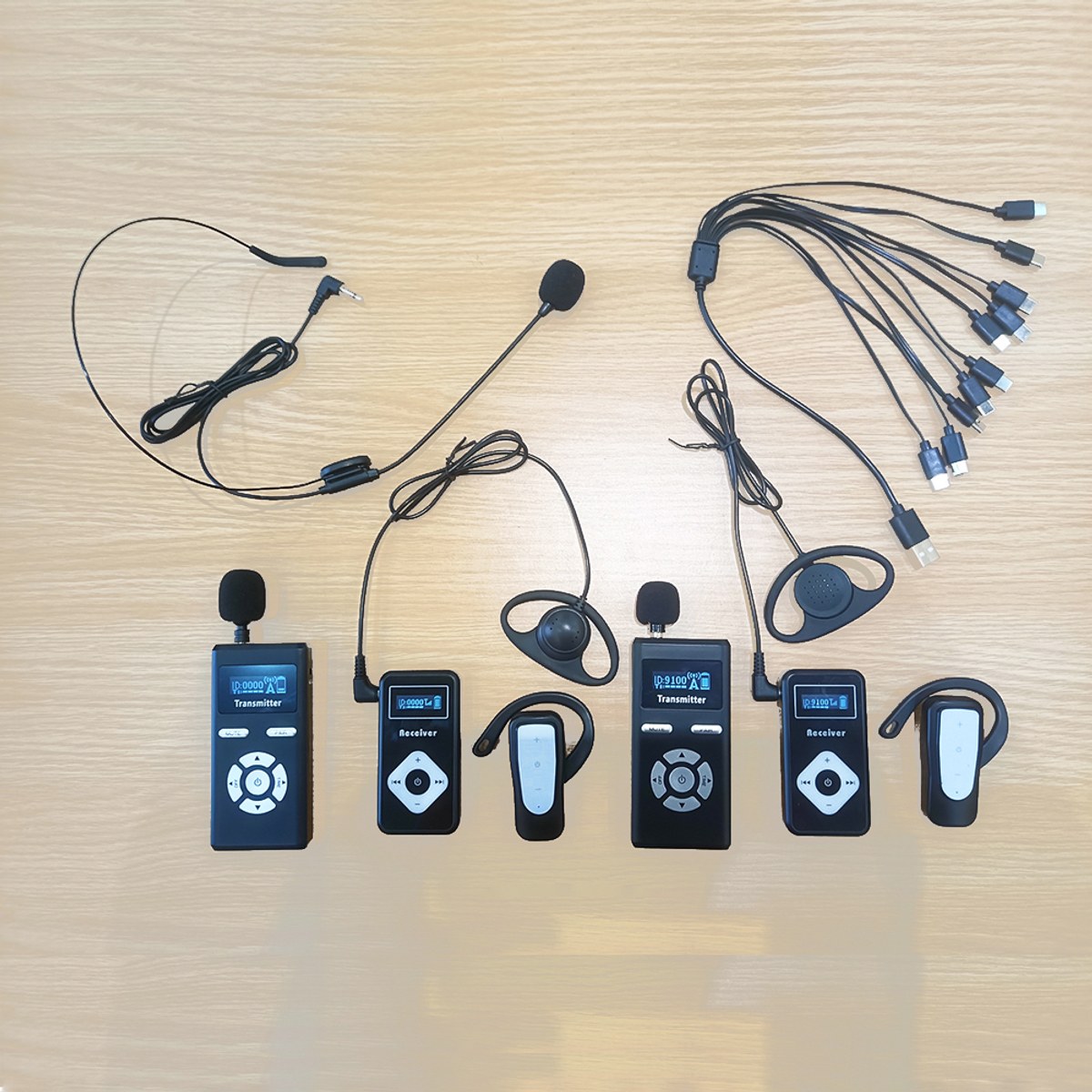
TG-208E and TG-208N: one guide, seven listeners
One transmitter, seven receivers and a multi-way Type-C charging cable. Right for a single docent with a small group, a trial before committing to a fleet. It charges from a cable rather than a case, so it stores in a drawer and travels in a bag for outreach and school visits.
TG-232E and TG-232N: two guides, thirty listeners

Two transmitters and thirty receivers in a 32-slot charging case. This is where most mid-sized museums land: two departures at once — two languages, or a public tour beside a school group. The case matters as much as the count, because the morning check becomes a glance at the LEDs instead of a count of loose units.
TG-264E and TG-264N: four guides, sixty listeners

Four transmitters and sixty receivers in a 64-slot charging case, built for large sites and rental desks that hand out a fleet every hour. Receivers in this family can hear two transmitters at once, so a curator can join a guide's channel for ten minutes without swapping hardware. For a single-guide starter kit there is also the TG-200; the full line sits in the wireless tour guide systems collection.
| Specification | TG-208E (8 pcs) | TG-232E (32 pcs) | TG-264E (64 pcs) |
|---|---|---|---|
| Configuration | 1 transmitter + 7 receivers | 2 transmitters + 30 receivers | 4 transmitters + 60 receivers |
| Charging | Multi-way Type-C cable | 32-slot charging case | 64-slot charging case |
| Frequency range | 2.4–2.4835 GHz | 2.4–2.4835 GHz | 2.4–2.4835 GHz |
| Modulation | GFSK, ±320 kHz | GFSK, ±320 kHz | GFSK, ±320 kHz |
| ID codes | 9,999 | 9,999 | 9,999 |
| Stated talking range | 492 ft / 150 m | 492 ft / 150 m | 492 ft / 150 m |
| Transmitter battery | 1,300 mAh, 25 h, 5 h charge | Same | Same |
| Receiver battery | 23 h, 2–3 h charge | Same | Same |
| Weight | 75 g transmitter, 25 g receiver | Same | Same |
| Typical use | One docent, trial fleet | Two simultaneous departures | Large site, rental desk |
The N and E suffixes are kit variants of the same capacity. Ask sales for each bill of materials before you standardise.
Six steps to a tour that runs without complaints
1. Charge overnight, count against the manifest
Twenty-five hours on the transmitter and twenty-three on the receiver mean one overnight charge covers a normal day. Count units against the slots in the case; a missing receiver is usually one plugged into a colleague's laptop.
2. Pair by ID, then write the map down
Pairing is by ID, not by hunting a clear channel. One ID per departure, written on the case lid and kept for the season — that map stops two guides landing on one ID.
3. Fit earpieces before hand-out
Fit earpieces to receivers before the group forms. A visitor holding a receiver and a loose earpiece will put the wrong end in their ear, and the first minute of the tour goes on fixing it.
4. Test at the furthest point of the route
Listen where the group will actually stand — behind the column, on the mezzanine, at the end of the long gallery. If audio breaks, raise the transmitter or change ID; do not ask the guide to speak louder.
5. Keep the mic capsule close and off-axis
The headset capsule decides intelligibility. A hand's width from the mouth, slightly to the side so plosives miss it, and the guide can speak at conversational level for two hours without losing their voice.
6. Collect and wipe on the way out
Collect at the exit and wipe earpieces before they return to the case. A visible cleaning routine is what lets a museum hand the same fleet out four times a day.
What to check before an institution orders
Spares ratio. Order about ten per cent more receivers than your largest departure needs. They get pocketed, dropped on stone and left in cloakrooms; a fleet with no spares cancels a tour the first time one goes missing.
Case or cable. Below 32 pieces a multi-way cable is enough. Above that, insist on the slot case: it is the difference between a one-minute morning check and a twenty-minute one.
Battery age. Both batteries are built in. Ask what the factory does about cell replacement in year three — this fleet outlives the warranty.
Interpreter, not translator. A human interpreter speaks into the transmitter; no TG model translates speech, and a supplier who implies otherwise is selling a different category of product.
Frequently Asked Questions
Does a wireless tour guide system translate languages automatically?
No. The TG range is an audio transmission system: the guide or a human interpreter speaks into the transmitter and visitors hear that voice in their earpiece. Machine translation is a different product category and is not part of this kit, which is why ACEMIC states on every TG product page that a human interpreter is required.
How many receivers can one transmitter feed?
Every receiver in range that is paired to the transmitter hears it, so the practical limit is the kit you buy: 7 receivers in TG-208E, 30 in TG-232E and 60 in TG-264E. For fleets larger than 64 pieces, ask sales to quote a custom split rather than stacking consumer kits.
Will 2.4 GHz interfere with the museum Wi-Fi?
The system shares the 2.4 GHz band with Wi-Fi, Bluetooth and access points, so it is not immune. GFSK modulation with 9,999 ID codes lets you move to a clean ID in seconds, and keeping the transmitter a metre or two away from an access point removes most of the risk. Test in the room that matters before a public opening.
What range can I expect inside a stone building?
Factory data states 492 feet (150 m) of talking range. Treat that as open-air line of sight: stone walls, cast iron columns and floors above and below all reduce it. Walk the actual route with a receiver in hand and check audio at the furthest point rather than trusting the number.
How long does a charge last across a full opening day?
The transmitter runs about 25 hours on its built-in 1,300 mAh battery and needs roughly 5 hours to charge; the 25 g receiver runs about 23 hours and charges in 2 to 3 hours. One overnight charge covers a normal day, and a lunchtime top-up covers evening events.
Can an 8-piece kit and a 64-piece kit be used on the same site?
Yes, as long as they are from the same 2.4 GHz GFSK TG family: pair each receiver to the transmitter it should follow by ID. Keep a written ID map for the site so a receiver borrowed from one kit still lands on the right guide.